
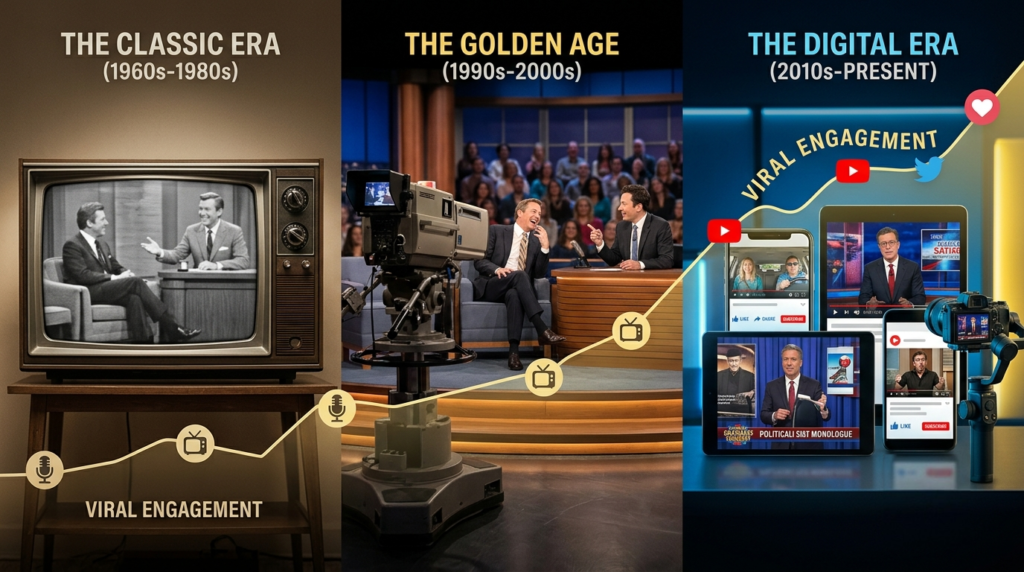

FOR DECADES, AMERICANS ENDED THEIR DAYS THE EXACT SAME WAY: TURNING ON THE TV, SETTLING INTO BED, AND LETTING A CHARISMATIC HOST TURN THE DAY’S HEAVY NEWS INTO COMFORTING LAUGHTER.
Late-night comedy television is a uniquely American institution. It isn’t merely a lineup of celebrity interviews or silly comedy sketches; it is the modern version of a campfire story—a nightly ritual that helps a nation digest politics, cultural shifts, and national crises before turning off the lights.
From quiet black-and-white conversations in the 1950s to viral YouTube clips and TikTok edits today, late-night television has undergone a radical transformation. Here is how a simple midnight talk show format grew into the ultimate cultural barometer of American life.
1. The Bedrock: Steve Allen and the Genius of Johnny Carson
Late-night TV didn’t invent comedy, but it invented a brand new way to deliver it. When NBC launched The Tonight Show in 1954 with Steve Allen, they stumbled upon a magic formula: a desk, an armchair, a house band, a monologue, and casual guest banter.
However, it was Johnny Carson who took over in 1962 and redefined American culture for 30 years.
Carson wasn’t aggressive or overly political. He operated as America’s ultimate bedtime host. Winning over Johnny Carson’s desk was the holy grail for young stand-up comedians; a single nod of approval from Carson could turn an unknown comic into an overnight superstar.
- What made the Carson era legendary:
- Unifying the country: Millions of Americans with vastly different political views watched the exact same show every night.
- The art of conversational comedy: Moving seamlessly from quick monologue punchlines to relaxed, unscripted couch chats.
- Creating the comedian pipeline: Serving as the definitive launchpad for the biggest names in American entertainment.
2. The Late-Night Wars: Sharp Wit, Rivalries, and Edgy Humor
When Carson retired in 1992, the peaceful late-night landscape erupted into intense network competition—famously remembered as the Late-Night Wars.
The battle between David Letterman and Jay Leno forced hosts to innovate. Letterman brought an irreverent, cynical, and self-aware brand of comedy that appealed directly to younger audiences, while Leno kept a broader, traditional style.
As the cable TV era took off, late-night split into distinct flavors:
- Conan O’Brien: Introduced surreal, absurd humor and physical comedy that built a massive cult following among college students.
- Jon Stewart (The Daily Show): Revolutionized late night by blending sharp political satire with real media criticism, turning late-night TV into a primary news source for a new generation.
By the 2010s, the traditional habit of sitting through a 60-minute television broadcast at 11:35 PM began to fade. Younger audiences stopped watching live television, forcing late-night hosts to adapt or face extinction.
Source: YouTube / WatchMojo.com
3. The Digital Era: Built for Social Media and Viral Moments
Hosts like Jimmy Fallon, James Corden, and Jimmy Kimmel pivoted toward bite-sized, highly shareable visual content designed specifically for YouTube algorithms.
Linear 11:35 PM TV Broadcast ➔ Segmented YouTube Clips ➔ Short-Form TikTok Hits
- Lip Sync Battles & Carpool Karaoke: Music-driven, celebrity-heavy sketches that quickly racked up hundreds of millions of views online.
- Monologue-driven political commentary: Hosts like Seth Meyers and Stephen Colbert doubled down on deep political analysis, turning their monologues into viral essays shared across social media the next morning.
4. Where Does Late-Night Go From Here?
Today, late-night comedy stands at a fascinating crossroad. The era of a single host uniting 20 million viewers in a shared bedtime routine is officially over. Audiences are fragmented, streaming platforms offer endless alternatives, and podcasts provide deeper, unedited conversations.
Yet, late night continues to endure. Why? Because during major cultural moments, national elections, or global events, people still look to late-night hosts to summarize the chaos with humor and humanity.
Final Thoughts: The Enduring Legacy of the Desk and Microphone
From Steve Allen’s informal chats to viral digital clips, late-night comedy in the United States has continuously reinvented itself. While the delivery method may shift from television screens to smartphone displays, the core human desire remains unchanged: we all want to close out our day with a good laugh.
Who is your all-time favorite late-night TV host? Do you prefer classic hosts like Johnny Carson and David Letterman, or modern viral formats? Tell us in the comments section below!